
18 September 2026
Like a character from one of the films he loves, Miguel Munuera took an unexpected turn away from the professional career he seemed destined for in finance. With dedication and a carefully thought-out strategy, he launched a YouTube channel focused on animation films. It proved to be the right decision: some of his videos have attracted two million views, while his community is now approaching 60,000 followers.
Born in Belgium but now based in Puerto de Sagunto, the Valencian town his family comes from, Miguel Munuera (Brussels, 1998) attended international schools in several countries as a result of his father’s career. He studied computer science and business administration in Madrid before completing a master’s degree in finance in London. None of this suggested that, just a few years later, he would be running and managing a YouTube channel that has become a favourite among discerning animation fans.
Just three years after uploading his first video, we spoke to this talented creator, who still has plenty of stories to tell and secrets to uncover.
You studied computer science and finance. How did you end up doing what you do today?
It has always been a dream of mine, ever since I was a kid. I’ve spent my whole life watching YouTube — it’s my TikTok, my Netflix. I grew up in that environment and always dreamed of having my own channel, but I didn’t know what it would be about. I’ve always been interested in cinema and I’ve watched thousands of movies, so a little over three years ago I thought that could be the topic I could start making videos about. I started out part-time, working on it after my day job, but gradually it evolved to the point where I was able to do it full-time.
How would you describe yourself professionally?
I’m a content creator who makes videos about animated films and, more broadly, about the animation industry around the world — from Japanese animation and Hollywood to indie studios.
What are your videos like? What defines and distinguishes them?
They’re between 15 and 20 minutes long, and I approach the topics more seriously, with more research behind them, than most YouTube channels that talk about animation. I go into greater depth to appeal to people who are already familiar with the subject, but I also keep casual viewers in mind. At the same time, I show a lot of my personality because that’s how I connect with the audience. The videos are very much me: my opinions, my emphasis, my obsessions.
With the endless amount of content available on YouTube, what sets your videos apart?
I put a lot of work into the production to achieve a level of quality that I consider optimal. Like the quality of the graphics, the fonts I use, the scenes I choose to illustrate what I’m talking about and, of course, the script. I want it to be obvious that a lot of care has gone into the production.
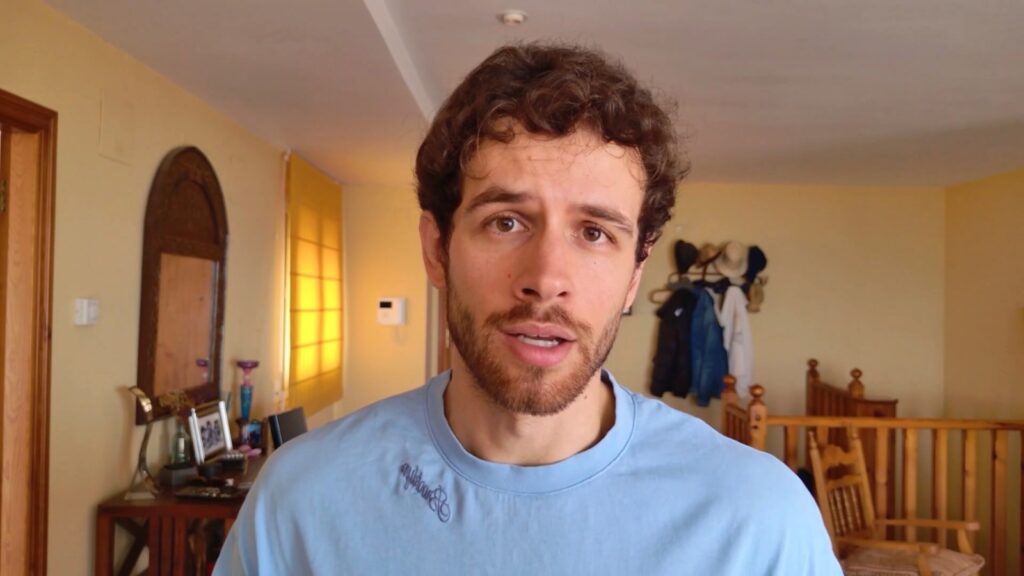
Miguel Munuera explains countless fascinating details in his videos.
Where did you acquire all these skills and this knowledge?
I’ve taught myself through trial and error, but I’ve also been inspired by the work of other creators. I watch YouTube every day, so it’s easy to figure out what you like about certain videos, but also what you’d like to try yourself — what kind of style you want to create, what editing effects you might use, how to work with lighting to make the image sharper…
Do you work alone?
I’m lucky enough now to work with people who are better than me at certain tasks, which means I can focus on the ideas and the thumbnail, for example, while my editors work on the video. That’s how you improve the production. Right now, I’m also talking to someone who is going to help me with research and scriptwriting.
How many days do you need to create a video, from the initial idea to publication?
I spend between 10 and 12 days on each video, which is why I publish every two weeks.
Why animation?
For several reasons. The first is that I love cinema in general, but it’s true that I have a soft spot for animated films. I grew up with Disney and Pixar characters, with cartoons of all kinds, and I think that has shaped the way I see the world. I actually started my YouTube channel reviewing films in general. My first video was about the 2nd spider-verse movie, the second was about Barbie* and the third was about *Oppenheimer, because I had originally planned to review all kinds of films. But one of the first videos I posted, about Studio Ghibli’s Princess Mononoke, performed much better than the others. I realised there was more interest in the subject of animation and perhaps fewer people talking about it. So I decided to take that direction and reach a larger audience.
Which is your most-viewed video?
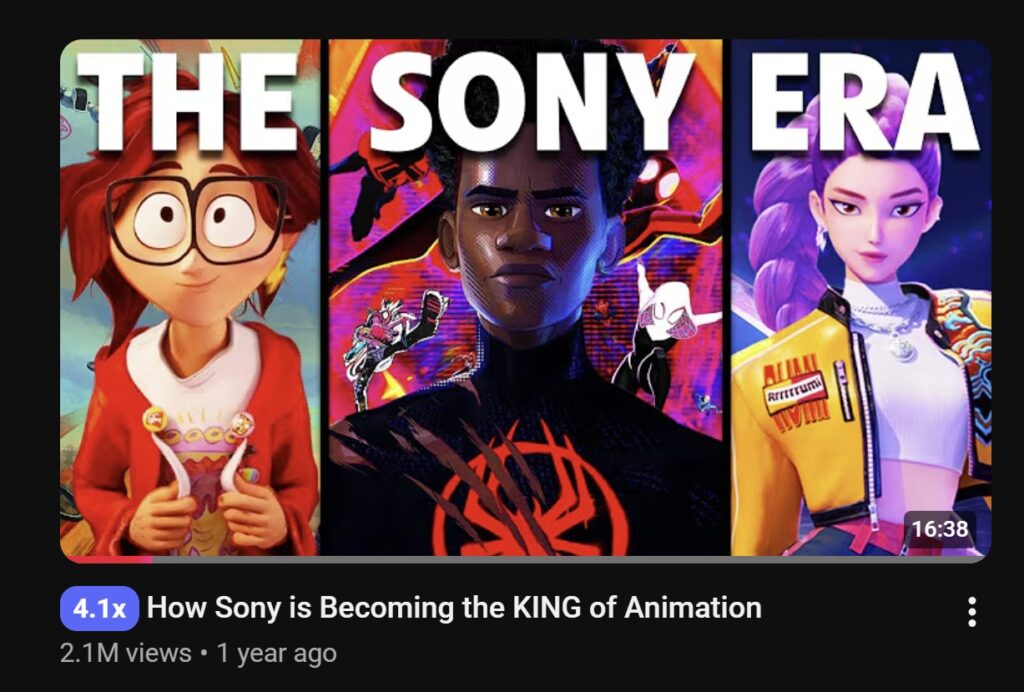
Right now, it’s ‘Why Sony Is Becoming the King of Animation?’, with around 2.1 million views.
What do you think is the key to that video’s success?
It’s a combination of things. First, the structure I used was one I’d already tested when talking about another animation studio, and it had worked quite well.
Sony is also an animation studio that’s been having a lot of success. When I published the video, they had just released a new film on Netflix called KPop Demon Hunters, which became a huge hit. Nobody expected it, but it went on to become — and still is — the most-watched film ever on Netflix, animated or otherwise, with more than 600 million views.
I released my video just before it came out, and the thumbnail featured one of the characters, so the video benefited from all the hype and popularity surrounding the film at the time.
Can you give me some examples of the subjects you’ve covered and explain how you choose them?
One of my most recent videos is ‘How Warner Bros. Killed a $17 Billion Cartoon Empire?’, in which I talk about how Warner Bros., the company behind the Looney Tunes, has mishandled the franchise over the past 20 or 30 years, causing it to lose its status as one of the world’s most popular animation IPs. It hasn’t disappeared, but its popularity has completely cratered.
Another video topic that did well was the animation studio Laika, which made Coraline in 2009. It’s a stop-motion studio — which is when you have physical, 3D characters and take photographs as you move the character slightly each time to create the film. It’s one of the most gruelling and complicated forms of animation because it requires so much time. I made a video talking about the studio because they’re releasing a film called Wildwood in October, which a lot of people are really looking forward to.
I also have a very popular series comparing the way Disney and Ghibli deal with particular themes. Ghibli is a Japanese studio and Disney is American, so they approach these subjects in very different ways. I’ve made several comparison videos, including one about how they portray love.
And how do they portray it?
Disney approaches it like Hollywood: as something perfect, the solution to all your problems, the thing you need to be happy.
Ghibli does the opposite. It shows the mundane side of relationships, the less romantic side — the arguments, the silences. Very often, the ending isn’t happy. The characters may not end up together. It’s a more realistic version of love.
What about Spanish animation? Have you published any videos about it?
I don’t know much about Spanish animation. I’ve seen trailers for some projects that look very interesting, ‘Robot Dreams’ is a great animated film that came out a few years ago and got nominated for the best animated feature Oscar, but it doesn’t seem as though animation is something the Spanish cultural industry is prioritising.
Is there a lot of competition on YouTube, or within the animation niche?
There’s a ton. There are more than 115 million active channels on YouTube, and 600,000 of them have more than 100,000 subscribers, which is a significant number. So yes, there’s a huge amount of competition, although there are proportionally far fewer channels dedicated to animation.
Do you have any direct competitors?
Not really, not someone who makes exactly the kind of content I do — in terms of tone, research and the range of subjects I cover.
There are plenty of channels that focus on a specific area, such as anime or Japanese animation, while many others focus exclusively on Disney. There are lots of specialised channels, but not as many that offer a global view of the industry.
Your videos seem to come quite close to journalism. You choose a subject and start pulling at the thread, looking for sources, comparing and fact-checking…
Exactly. There are videos that are more story-based in nature, but certain topics lead me to traditional journalism. I have to rely on a lot of articles to show certain things that have happened; they’re backed by proper sources. For example, one of my most popular videos talks about why the third movie in Sony’s Spider-Verse trilogy is taking so long to come out. That video was pure investigative journalism: it talked about why, who had said what, etc.
First comes the idea, but then how does the work actually start?
I think a lot about ideas and topics that might interest my audience. It’s actually quite tough for me; even though I’ve been doing this for three years, it’s hard to know what ideas will be interesting and successful. So, the first thing I do is look at my list, where I have more than 200 ideas, while also generating new ones based on things happening right now. I pick one, and then I create the video thumbnail (which is like the cover). That’s one of the most important steps, because if people don’t click on the video, it doesn’t matter what you say. If I don’t have a clear idea of how to communicate the topic visually to the audience, I switch ideas.
Once the thumbnail is done, I start researching. I look for articles, go through them, highlight parts, make an outline of what I want to say, and start writing. Recording is the easiest part. Editing is what takes the most time. I decide whether to include graphics to explain concepts, select the video clips, choose the music…
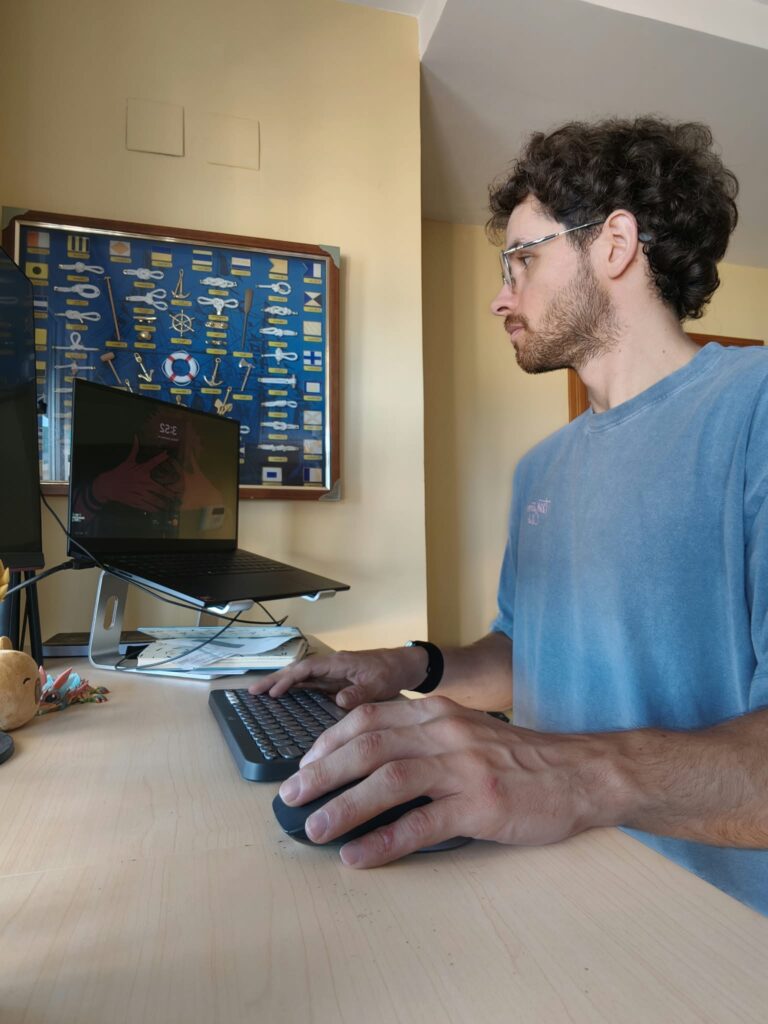
Miguel Munuera editing one of his videos
What can you tell me about your community, those nearly 60,000 followers? What do you know about them?
Most are from English-speaking countries—about 40% from the United States, plus the UK or Australia—and a portion is Japanese. They tend to be my age, although I have viewers ranging from 13 to 60 years old. There are two camps sort of: a huge percentage of my audience loves Japanese animation, anime, and Studio Ghibli, while another massive chunk consists of Disney and Pixar fans, along with other similar Hollywood studios.
Can you tell me some of your favorite movies?
My favorite live-action movie is Good Will Hunting, and for animation, it’s Howl’s Moving Castle.
Do you have a particular weakness for any studio?
It’s hard to pick a favorite. I love Studio Ghibli, but I also grew up with Disney, with movies like The Lion King, which I adore. I’d say I’m a big fan of several studios.
Is the main audience for animation made up of children?
At first, in the 1930s and 40s, it was actually aimed at an adult audience, but that shifted with the arrival of Disney and, above all, the massive success of their 1990s movies (The Lion King, Beauty and the Beast…). However, over the last 20 years, that has changed significantly thanks to the explosive popularity of anime in the West, which targets all age groups, but mainly older audiences. That has made people seek out more mature animation like that, not just content for kids and families.
And of course, there are quite a few studios making more adult, mature animation, though the most famous ones, like Disney and Pixar, insist on making only safe movies so entire families can go. This has been a major topic of debate in recent years because people who grew up watching animation want adult themes from their favorite studios.
For an adult who is new to animation, what movies would you recommend?
Spirited Away, Princess Mononoke, and Grave of the Fireflies—which is one of the hardest movies I’ve ever watched in my life.
What are your dreams?
I’d like to become the standard for video essays about animation, like MKBHD, an American YouTuber who has been making tech videos for 15 years and is one of the most popular in that niche. He keeps making incredible, revolutionary videos. He takes meticulous care of every detail and has a pretty large team. I want to reach that level of production quality while discussing the topics I cover.
I have more superficial goals, like reaching a million subscribers, but long-term—in 5 or 10 years—I want to keep making YouTube videos about animation to show fans that there is life beyond their own bubble. I want to talk about independent European studios, or Asian ones outside Japan (China is growing quite a bit too). I want to gain enough influence to help these smaller studios reach a wider audience.
Which animated character do you identify with?
I’d say a mix between Simba from The Lion King, Jim Hawkins from Treasure Planet, and Flynn Rider from Tangled. Simba when he was younger—more innocent, sensitive, with my emotions on my sleeve. Flynn Rider for the romantic side, and Jim Hawkins for his bravery and ability to chart his own path. I stepped out of the traditional bubble and what was expected of me, to start my own journey, along with all the risks that entails.
Do you keep track of all the movies you’ve watched in your life?
No, though I have for the last three years: 328. It’s not a crazy amount, but hey, not bad.
https://www.youtube.com/@miguelmunuera2601